
Conservatives Can Win Culture Back By Thinking Upstream
The Left is quickly losing the plot on culture, it's up to us to seize the day

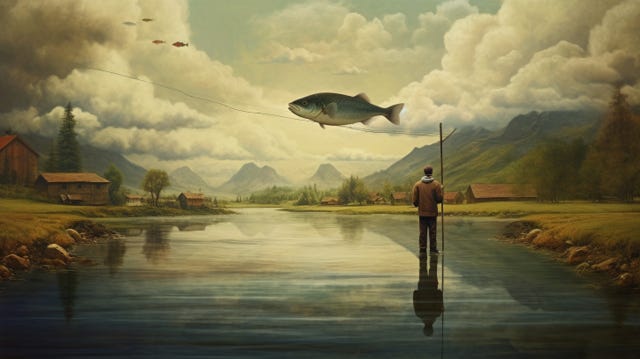
"Politics is downstream from culture." Andrew Breitbart’s insight is not only ever more relevant, but also represents a conservative reversal against an eminently Gramscian idea; it is cultural appropriation at its finest.
Antonio Gramsci noted that ruling classes maintained power not just through the monopoly on violence or economic control, but mainly by influencing cultural norms and beliefs. This, in turn, shaped political systems — a phenomenon he termed ‘cultural hegemony’.
Side note: It is interesting how the BLM rioting and the growing phenomenon of legal shoplifting also represent an expansion of the monopoly on violence to include other protected classes.
One of the godfathers of Cultural Marxism, Gramsci deviated from Marx's stance. Marx was a firm believer in economic determinism — that economic factors, such as wealth distribution, are the primary forces shaping society. In Marx's view, political structures arise mainly from economic relationships. He believed that government and laws exist primarily to protect the interests of the capitalist class.
Interestingly, Gramsci's thoughts seemed to align more with Max Weber, who was considered Marx’s nemesis. Weber’s magnum opus, The Protestant Ethic and the Spirit of Capitalism, provided a counter-argument to Marx’s theories, asserting that that various factors, including economics, politics, culture, and ideas, all play a role in shaping society.
More recently, Sir Roger Scruton extensively discussed the loss of beauty and the rise of utilitarianism and its societal and cultural effects, arguing that beauty is an objective value and an integral part of the human experience, playing a significant role in various areas of life, including art and architecture, which ultimately shape society, politics, and even morality.
Scruton was highly critical of modernist architecture and urban planning, which often lack beauty and fail to resonate with the human spirit. He advocated for more traditional and classical forms of architecture that harmonise with human nature and culture. He believed that utilitarianism failed to account for the importance of aesthetic and spiritual values, which can't be easily measured or quantified.
Reading Scruton, it becomes quite evident how the Left's cultural hegemony could lead us to be enclosed within the confines of 15-minute cities.
So, Breitbart, by flipping Gramsci's ideas on their head, illuminated the path, and Scruton spelt it out in case we still couldn’t understand it. It’s not like we don’t know that, so what happened? Why did we become complacent, allowing conservative beauty to be replaced by progressive utilitarianism in our culture? Did we also sell out?
It seems to me that conservative culture suffered a brain freeze since the so-called 'end of history' period, an idea that still echoes in many minds. While we assumed a peaceful common culture, the Left viewed it as a colonising, oppressive culture that needed to be defeated, and they worked relentlessly to dismantle it.
As the cauldron that had been simmering boiled over during the internet and social media era, the inevitable happened. We had not considered taking on the role of counter-culture, but here we are. The Overton Window has shifted, and we find ourselves out of the picture.
The Douthatese Falcon
But not all conservatives have been defenestrated from mainstream culture. One of the most shining examples of a conservative who occupies a rare, prestigious position in mainstream culture is Ross Douthat, NYT columnist.
“I wrote a fantasy novel. What should I do with it?” Ross recently announced his new project The Falcon’s Children. I like him a lot. So, I was very excited to find out that he is further advancing on the flanks of the culture war. Even though I don’t like the format — the only fantasy book I remember finishing was The Return of the King — I read the manuscript Douthat shared.
Beautifully written, it comprises a prologue and a chapter one, which seem to both contrast and complement each other in very non-obvious ways. It left me wanting for more, eager to understand the connections, but also with the feeling that reading it would require quite an investment. Still, I’d do it.
Douthat is a talented, creative writer, but somehow he is confining himself to the world of political/social commentary, relegating his fiction endeavours to the sidelines, arguing that “the pace of my professional writing life doesn’t leave much time for long experiments.”
And that’s where I start having problems with his approach. To me, he is succumbing to the sort of reductionism that Scruton warned us about when pointing out that utilitarianism tends to reduce complex moral issues to a single scale of value, which can oversimplify and misrepresent the richness and complexity of human life. Non-fiction is utilitarian. Useful, but not beautiful.
Again, Douthat understands that, so much so that he tells us his project is “a rather fat, overly ambitious, probably-undercooked attempt at the first novel of a fantasy trilogy.” But that’s what beauty requires. That’s why Homer, Virgil, Dante, and Camões wrote in poetry (a format I’m not quite fond of) because the appreciation of beauty requires labour and ambition. So if Douthat is going to distill his rich intellectual thinking into fiction, he will have to do the heavy lifting that the appreciation of beauty requires.
Proving that not only does an author writes a book, but a book also writes an author — which can be both rewarding and punishing when you think about it — Douthat acknowledges that “it’s quite possible that the book needs to be set aside for a long while, or just treated as training for a better novel down the road”.
That sentence in his announcement really shocked me. Because this is the man who, in his latest book The Decadent Society, discusses exactly the need for society to go to bat for that. He diagnosed the “sustainable decadence” of Western society as a combination of our ridiculous wealth, technological proficiency, political stalemates, cultural exhaustion, and demographic decline. And now he is telling us that writing a generational fiction piece is cumbersome because he would have to deviate from his day job, he is afraid he is overly ambitious and not yet up to the task. So, the rest of us are doomed. Quite simply.
Moreover, from the moment he acknowledges the political and societal manifestations of it, and the need for cultural renewal that is so dear to him, he cannot fail to realise that he is in a unique position to help instill new ideas and intellectual energy behind the rediscovery and recommitment to shared values, institutions, and civic virtues.
Sure, he is one of the conservative standouts doing it from the ‘top-down’ through political analysis. But if you pick up the recent books by these conservative standouts, they are always lamenting and bemoaning the end of society, from Douthat’s The Decadent Society to Ben Shapiro’s The Authoritarian Movement to Dinesh D’Souza’s Death of a Nation. They do a lot to painstakingly paint the picture of the taxonomy of the conservatives’ cultural defeat. They do very little to reverse it or swim upstream. We need fiction for that.
Of course, one of the reasons for decadence is that we keep procrastinating, while the Left keeps pushing. Douthat says we’ve become victims of our own success and are now locked in a state of malaise, in which our culture and politics feel exhausted. His very definition of a ‘decadent society’ is that we’re trapped in a stale system that keeps spinning in place, reproducing the same arguments and frustrations over and over again. Then he asks us:
“If you have any thoughts, reactions or strong feelings at what I should do with the book — burn it, bury it, self-publish it […] consider shooting me an email at falconschildren@gmail.com”
So I’m writing him back, and I think you should do the same.
Creative Construction
“If a writer of prose knows enough of what he is writing about he may omit things that he knows and the reader, if the writer is writing truly enough, will have a feeling of those things as strongly as though the writer had stated them. The dignity of movement of an ice-berg is due to only one-eighth of it being above water. A writer who omits things because he does not know them only makes hollow places in his writing.”
Ernest Hemingway, Death in the Afternoon
Hemingway was — unlike Douthat — known for his frugal approach to wordsmithing, a technique he encapsulated under his idea of an ‘iceberg’. In many ways, fiction (irrespective of affiliation) has mirrored this approach, with conservative writers treating the promotion of conservative ideas (around gender roles, patriotism, sacrifice, etc.) as a sort of cultural concealed-carry.
Over the last decade — at least — the Left has broken with this principle. While conservatives took a backseat in culture, the Left started to feel comfortable openly pushing their agenda through cultural products, ranging from hit songs to best-selling books, Oscar-winning movies, and lackluster Netflix series, even extending to the remake of children’s classics.
This presents the first opportunity for conservatives to seize the day. The feeling of alienation and pushback is real. Just look at Budweiser. As clumsy as it was, the Bud Light boycott provided a clear example that conservatives can also play the ‘creative destruction’ game.
However, there is a caveat for conservatives — as, of course, Coors and Miller are just as woke as Budweiser. The problem here is that creative destruction is not enough. We need to build — or restore — something in its place.
We haven’t had an opportunity like this for a long time. If the Left is willing to forgo the middle ground by openly promoting an extremist agenda, it means the cultural mainstream is now up for grabs.
The second opportunity has to do with AI. If you've dabbled with any of the most common models available, it’s obvious they are trained on a cross-section of mainstream media talking points and left-wing propaganda, incapable of generating interesting debates or intriguing ideas. AI-generated content is ‘more of the same’ and completely undifferentiated compared to mainstream writing.
So, AI, with its multiple permutations of left-wing talking points in a closed-loop circuit, presents a threat to the current left-wing media establishment. The new ideas, the different perspectives will have to come from somewhere else, not from contemporary culture. And the incumbents know that.
Just look at the WGA writers' strike. Their initial argument of stopping the production of shows did little to convince the public to join their side. That’s the equivalent of telling me we’re about to starve because McDonald’s is on strike. Who's going to poop on our statues now that the pigeons are gone?
The truth is that ChatGPT can do their job and will do their job. They are now resorting to guerrilla tactics like picketing productions and photobombing movie shootings. It's sad and pathetic.
But to occupy this space, conservatives need to think upstream and deal with a different type of iceberg. At the tip, you have news, then you have analysis below it, and then you have fiction as the basis for the whole thing.
Because it is fiction that will capture people’s hearts and minds, giving them the archetypes — the mental models — to understand the world. The archetypes from classical literature (the hero, anti-hero, rebirth, sacrifice, rags to riches) have been replaced over time by the archetypes of contemporary culture (white privilege, greedy capitalist, social justice warrior, minority victimhood), and that percolates (up, if I may say so) all the way to how the news is presented. That’s how George Floyd is normalised as an icon and Daniel Penny as a villain.
Conservatives are doing a great job on all other levels. We’ve got the news (even with the recent losses of Fox News and Project Veritas) and we’ve got the political analysis, with a growing stable of well-rounded, successful conservative pundits with large, independent platforms.
In movies, there’s been a conservative renaissance with a number of interesting documentaries such as What is a Woman? and 2000 Mules, as well as dramatisations like Gosnell, Unplanned, and My Son Hunter — which I reviewed here. However, they are all based on true stories and subject to litigation. Again, we need fiction fiction.
This is the golden age of the creator economy. The prevailing narratives are growing stale, production costs are declining, and the demand for fresh ideas is at an all-time high. Censorship, elitism, and class privilege are on the decline. It’s up to us to seize the day.
As for me, I’m doing my part. I’m currently 40,000 words into my first novel. Culture is an edifice, so I’ll add a few bricks to it. They might not be the prettiest or most impressive bricks, but they will be there. I will probably need a good editor, or any editorial assistance I can get. Any pointers are much appreciated — feel free to contact me at caufskiviers@gmail.com.
If we don’t start thinking upstream, we will eventually grow tired of swimming against the current.
The preamble was not ratified and is not part of the founding document. Our Confederation and perpetual Union is/was named The United States of America in 1777. The Declaration is of the 13 colonies not Independence. The perpetual Union was broken the first time by Rhode Island and Providence Plantation. It was repaired by its return prior to Vermont.
The United States of America created the Constitution as an Article of the Confederation and perpetual Union the United States was created as a government service company. There are only two names. The other iterations are bogus and de facto. United States of America is not either name thus bogus. There is no lawful federal anything, that is part of the deception. United States has enumerated responsibilities. It is correctly written The United States of America's Constitution circa 1859 that is original jurisdiction after Oregon became one of the several states and before South Carolina seceded from the Confederation and perpetual Union.
The goal is to return to a Constitutional republican form of government this year 2023. We flipped Oregon back to a de jure jurisdiction and proper Constitution and law form in 2022.
What took us 4.5 years doing it one step at a time can be done by 5 people doing 15 hours work, 50 bucks in postage and 40 bucks for a seal? Then work on gathering a Jury Pool while waiting for the docs to cure 21 days in de jure and 30 days in de facto.
Let's suppose we have a posterity. The reality of the JAB will become known by 2025, some judge the population of 350,000,000 will be reduced to 95,000,000 men and women capable of self determination. It seems we will have a huge population of injured and dependent people. We really need to return to a Constitutional republican form of government , NOW, would be good.
Have you any rebuttal to our claim? Who else has a solution?
Running for office and voting in the current de facto is not a solution.
www.orsja.org is working for Oregon. It is transferable, quick cure time.